Tree-walking Interpreters
How do we go from code in an IDE to seeing something print out in the terminal?
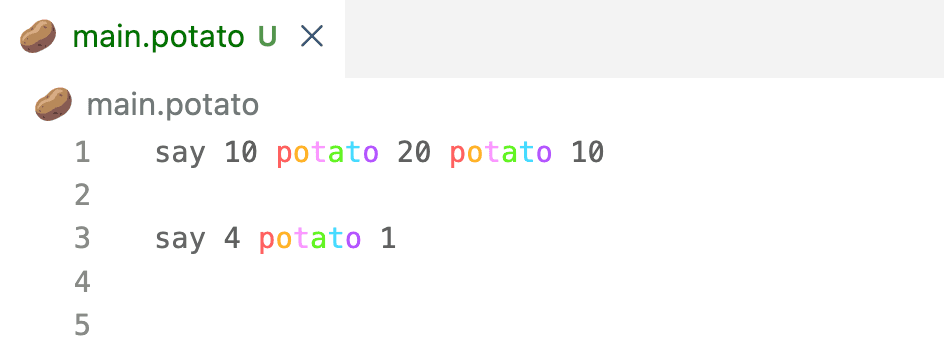

Turns out, computers don’t really mind what we write in our files, as long as we can teach them how to read the code
Say Potato
Whether the syntax looks like print(2+4), say 2 potato 4 or even 🖨2️⃣🤝4️⃣, an interpreted language will be broken down into something the interpreter, a program that executes code at runtime1, understands
Interpreted languages are often contrasted with compiled languages, which produce executable instructions during a build step, before the code is run1
Some interpreted languages will go through steps:
Source → Tokenizer → Parser (AST) → Interpreter → OutputTokenization
Tokenization breaks code into chunks called lexemes, essentially the raw characters of a file. Each lexeme is then classified into a token and given a type so the parser knows what to do with it2
+is a lexeme, which becomes a token when we decide what it represents - typically, the addition operator
Many languages break tokens into types including: keywords (if, else), literals (strings, numbers), identifiers (variables), operators (+, %), and separators (:, ;)2
Potato only recognizes:
- one keyword,
say(logs its result) - one operator,
potato(sums its left and right) - and number literals
🍠 main.potato

say 2 potato 4
The above example can be broken down into tokens:
[:PRINT, :NUMBER(2), :ADD, :NUMBER(4)]# Splits lines of a files into
# lexemes and creates tokens
module Potato
class Tokenizer
def self.tokenize(line)
line.strip.split(/\s+/).map do |token|
case token.downcase
when "say" then Token.new(:PRINT, nil)
# Whenever the tokenizer sees the word potato,
# we can ask it to create an addition operator
# really, this could be any word or symbol :)
when "potato" then Token.new(:ADD, nil)
when /^\d+$/ then Token.new(:NUMBER, token.to_i)
else
raise "Unknown token: #{token}"
end
end
end
end
endParsing
Now that we’ve broken down our code, we need to piece it back together and give it structure
Like in human languages, to parse means to take input and give it meaning3
The parsing step will transform Potato’s tokens into a tree representation, referred to as an Abstract Syntax Tree (AST)4, that will help the interpreter understand the relationship between tokens
module Potato
  module AST
    Node = Struct.new(:type, :value, :children)
  end

  class Parser
    # Builds an AST that describes
    # the relationship between tokens
    def self.parse(tokens)
      # ...

      numbers = tokens.select { |t| t.type == :NUMBER }.map(&:value)
      add_node = AST::Node.new(:add, nil, numbers.map { |n| AST::Node.new(:number, n, []) })
      print_node = AST::Node.new(:print, nil, [add_node])

      Interpreter.eval(print_node) # Potato only knows how to print out numbers
    end
  end
end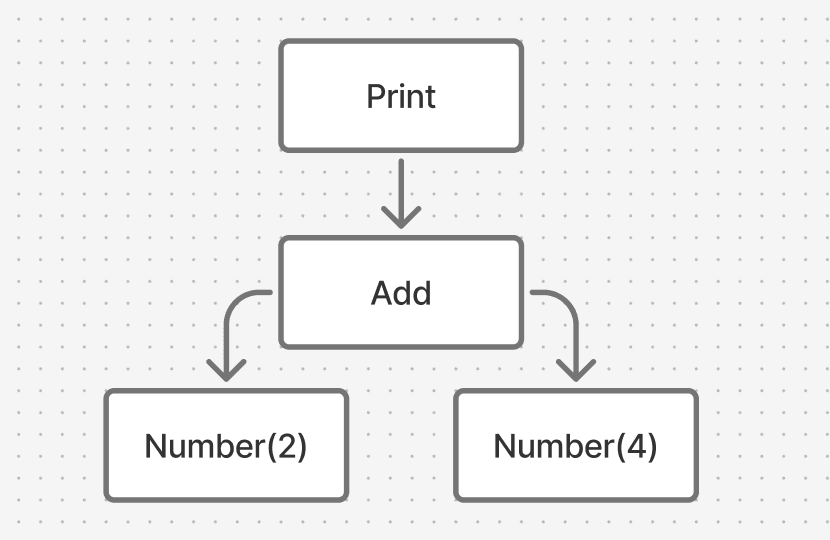
If we pretty printed the AST, it might look like:
Print
  Add
    Number(2)
    Number(4)
Interpreting
Mentioned above, interpreters are programs that execute code. How they do so can differ by implementation5
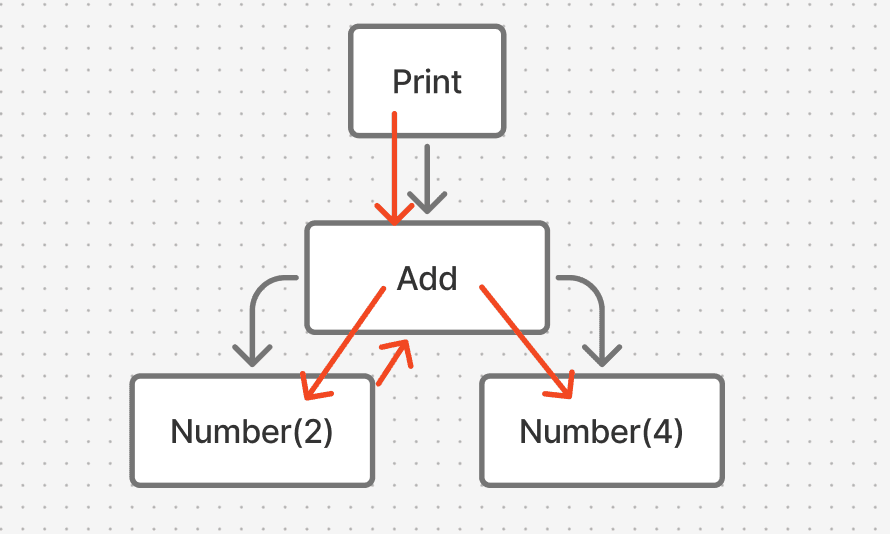
Potato is based off of a tree-walking interpreter, which executes code by traversing its AST depth-first. Depth first traversal helps ensure that expressions are evaluated in the correct order6
Tree-walkers are named due to the fact that they.. you guessed it:
traversewalk the Abstract Syntax Tree
module Potato
  class Interpreter
    # Recursively visit each node and
    # do something based on its type
    # Print > Add > (Number(2) + Number(4))
    def self.eval(node)
      case node.type
      when :print
        result = self.eval(node.children.first)
        puts result
      when :add
        node.children.map { |child| self.eval(child) }.reduce(:+)
      when :number
        node.value
      end
    end
  end
end
TLDR;
Root vegetables can take the place of operator symbols because computers don’t care what our source code looks like. Instead, we show them how to interpret meaning by breaking up the file and putting it back together:
Source → Tokens → AST → Tree Walk → Output- Tokenization: What are these things?
- Parsing/AST: How are these things related?
- Interpreting What should we do with these related things?
Resources
- 1 Introduction to Compilers and Language Design, University of Notre Dame
- 2 Lexical Analysis
- 3 Parsing
- 4 Crafting Interpreters, Robert Nystrom
- 5 Interpreter
- 6 Processing ASTs: Tree Walking, University of Rhode Island